Analysis Of The Medicinal And Aromatic Plants Sector In Türkiye And Some Recommendations
1. INTRODUCTION
The use of medicinal plants for healing purposes by humans dates back to the earliest periods of humanity. Civilizations that lived in Ancient China, Ancient Greece, India, North Africa and the Arabian Peninsula mentioned treatment with plants in written sources. The World Health Organization (WHO) reports that approximately 4 billion people in the world try to solve their health problems primarily with herbal drugs. The global herbal medicine industry is growing rapidly with the increasing consumer demand for natural and alternative health care options.
It is estimated that the global herbal medicine industry will grow from $231.87 billion to $428.08 billion by 2031 and will exhibit a compound growth rate of 9.15% during this period. Considering whole plants or powders of drugs such as origanum, rosemary, sage, mint, marjoram and bay leaf, the global market is projected to grow from $5.8 billion in 2022 to $6.17 billion in 2023 and reach $7.93 billion in 2027. When considering more refined forms such as capsules, tablets and extracts, the global market is estimated to reach $117 billion by 2029 with an annual growth rate of 7.3%. Located between the continents of Asia and Europe, Türkiye has held a significant place in the trade of both herbal medicines and spices for centuries (6).
Although the exact number of medicinal plants used in Türkiye is unknown, it is estimated to be around 500; it is stated that approximately 200 medicinal and aromatic plants have export potential. However, currently, 131 medicinal-aromatic plants are included in the Ministry of Agriculture and Forestry's list (1,2,3).
Türkiye has significant economic potential due to the presence of many plant-based products in its flora that are raw materials in the herbal medicine, plant-based chemical substances, food additives, and cosmetics industries, which are used extensively in developed countries. This rich flora, which increases Türkiye's competitiveness in exports, has significant value within the national economy. Sustainable production of the Turkish Plant Association (TPA), the protection of biodiversity, and the promotion of agricultural practices that respect ecological balance are vital for the long-term sustainability of this sector. In addition, the development of this sector brings with it investments in research and development activities and scientific studies, thus contributing to both scientific knowledge accumulation and creating economic value (6).
2. ECONOMIC IMPORTANCE OF MEDICINAL AND AROMATIC PLANTS (MAPs) IN TÜRKİYE
Türkiye ranks among the top 20 countries in the world in the production and trade of medicinal and aromatic plants (MAPs). Our country is a major producer of MAPs, primarily origanum, cumin, bay leaf, aniseed, black cumin, coriander, fennel, fenugreek, lavender, mahlep, rose, poppyseed, sage, sumac, and tea. Thanks to support programs, MAPs such as origanum, Anatolian sage, thistle, blueberry, caper, chamomile, mint, garden mint, bay leaf, lavender, lemon balm, mountain tea, nettle, passionflower, rosehip, rosemary, salep orchid, goldenrod, St. John's wort, tarragon, and yarrow are now widely cultivated. In recent years, interest in medicinal and aromatic plants and the products derived from their production and use has continued to increase significantly.
The main reasons for the widespread cultivation of medicinal and aromatic plants in recent years can be listed as follows:
1. Change in crop pattern: In the early 2000s, restrictions (quotas) were imposed on tobacco fields in the Aegean Region, as in all of Türkiye. During these years, tobacco producers began searching for new alternative products to tobacco. It was precisely at this time that origanum began to become an important export product. Through the efforts of the private sector (Kütaş A.Ş.) and the Denizli Provincial Directorate of Agriculture, origanum and sage production was initiated in the high-altitude (400-1200 m) villages of Denizli.
2. Its use in alternative medicine
3. The increasing trend of all people towards natural and organic products in recent years
4. The growing importance of spice plants
5. High export potential
6. Its cultivation is easier and perennial compared to other products (tobacco, cotton)
7. Its yield per unit area is higher compared to other products
8. The increasing use of essential oils obtained from medicinal and aromatic plants
9. In recent years, financial support has been provided to farmers by the Ministry of Agriculture within the scope of IPARD-TKDK-rural development projects for medicinal and aromatic plants (1,2,3).
Export and Import Values of Medicinal and Aromatic Plants in Türkiye
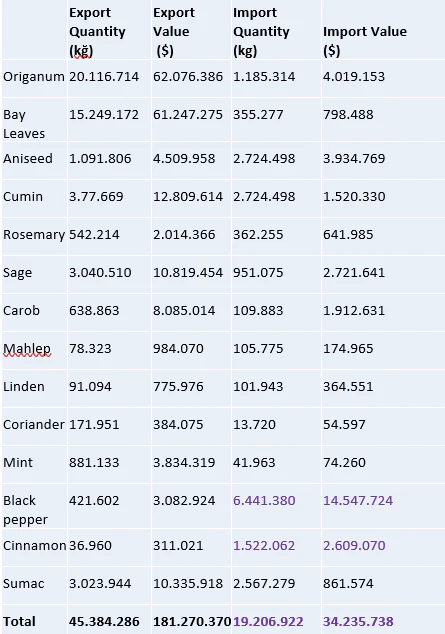
With the increasing interest in medicinal and aromatic plants every day, the demand for these plants and the products obtained from them is also rapidly increasing. Therefore, the contribution of these plants to the country's economy has become significant. Indeed, significant increases have been recorded in export and import values in the world and in Türkiye over the years. When the import and export values of Türkiye, which has a rich biodiversity in terms of medicinal and aromatic plants, are examined; it is seen that there is a regular increase in both export and import values between 2010-2023, but in some years there is a decrease in the import and export values of medicinal and aromatic plants compared to the previous year (Table-1-2). Medicinal and aromatic plant exports, which had a total export value of approximately 56 thousand tons and 157 million dollars in 2010, increased to approximately 72 thousand tons and 225 million dollars in 2023. Among the plants that were exported the most during these years, as of 2023, origanum ranked first, followed by bay leaf and poppyseed, sage, sumac, and cumin (Table-1,2).
Table-1: Türkiye's Exports of Important Medicinal and Aromatic Plants by Year,2024 (Turkish Statistical Institute) (Aegean Exporters' Associations) (Tons)
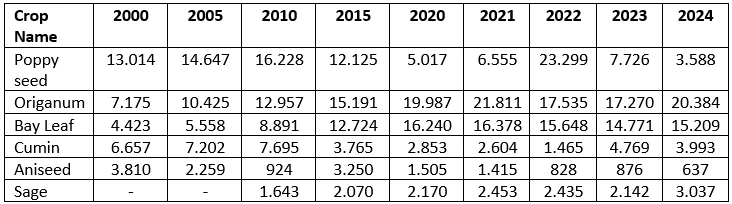
An examination of Türkiye's imports of Tobacco and Alcoholic Beverages (TOBs) between 2010 and 2023 reveals that import quantities ranged from approximately 23 million to 61 million, while import values varied between 40 million and 97 million. As of 2023, the TOBs with the highest import quantities and values were found to be black pepper, cinnamon, aniseed, cumin, sumac, and origanum.
Table-2: Türkiye’s Export and Import Quantities and Values of Medicinal and Aromatic Plants in 2024 (7).
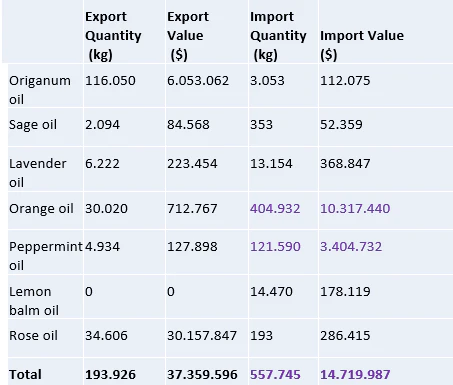
When the export and import values of essential oils of Türkiye are examined, it is seen that there has been an increase in essential oil exports from 2010 to 2023. According to the 2024 data, the most exported oils are rose, orange and thyme oils, and the most imported oils are orange, mint and lavender oils (Table-2,3) (6,7).
Table-3: Türkiye's Essential Oil Export and Import Quantities and Values for 2024 (7).
3. PRODUCTION AND INCREASE OPPORTUNITIES OF MEDICINAL AND AROMATIC PLANTS
Our country's ecology is suitable for the cultivation of many medicinal and aromatic plants. Obtaining standard, homogeneous, high-quality products and higher yields per unit area is possible by cultivating these groups of plants. A roadmap to be followed in this regard is important. In 2000, the production, which consisted of 7 plants including tea leaves, aniseed, poppyseed (capsule), cumin, pepper (dry unprocessed), garlic, and hops, which were included in the Turkish Statistical Institute (TÜİK) statistics, increased to 23 plants in 2023. In addition to these, there are many medicinal and aromatic plants that are not yet included in the statistics but whose cultivation has begun.
According to the 2023 data; the planting/cultivation area of medicinal and aromatic plants is 1,947,323 decares, and the production is 1,934,048 tons. An examination of the changes in medicinal and aromatic plant cultivation in our country between 2000 and 2023 reveals a 20.02% increase in planting area and a 115% increase in production. Reasons for this increase include: selection of plant species suitable to the ecosystem, an increase in the number of registered varieties, the use of appropriate cultivation techniques, government subsidies, high byproduct yields, and an increase in the number of producers and informed consumers. The increase in planting area for plants such as origanum, black cumin, lavender, sage, and capers, and the decrease in aniseed, fennel, broom, and hops are noteworthy. These fluctuations are reflected in the production quantity. According to 2023 data, tea, poppy, origanum, cumin, garlic (dried), pepper (dried), aniseed, black cumin, lavender and rose (oil) constitute 95.85% of the total cultivation area and 96.84% of the production of medicinal and aromatic plants, and are the plants that guide the sector in our country (6,7).
Türkiye has the largest origanum plantations (200,000 decares) and is a major player in world trade. Especially in thyme cultivation, there is clustering, so the market opportunity is greater and the processability (20,000 tons) is high. The increase in the number of registered varieties and the contribution of the private sector keep origanum farming alive. However, in recent years, due to the presence of Pyrolyzidine (PA) and Tropan in the product obtained from origanum, cumin and mint cultivation due to some weeds, the EU market is turning to alternative countries such as Greece and Albania. Regarding the problem of plants containing alkaloids (pyrrolizidines), the ministry should identify the plant species and weeds containing them, provide regular training to farmers, and demonstrate the consequences of weed problems (1,2,3,6).
The decrease in aniseed cultivation areas was determined to be 83.27% between 2000 and 2023. In parallel with this decrease, the production quantity has also decreased. In anise, the low yield is generally due to the use of population-type seeds, the inability to irrigate during certain development periods, and the diseases encountered. Aniseed producers have turned to other products due to price fluctuations and low purchase prices over the years. A large portion of the anise seeds produced in Türkiye are used in the production of the alcoholic beverage called "rakı". With the introduction of newly registered varieties to the producer level in recent years and the demand for anise produced in Türkiye in rakı production, an increase in anise cultivation areas is expected in the coming years.
Türkiye is one of the important cumin-producing countries. Examining the changes in cumin cultivation areas over the last twenty years reveals a lack of regularity, and consequently, variations in production values from year to year. The plant's short vegetation period, low water requirements, and ability to utilize early spring rainfall effectively, along with its potential to utilize fallow lands, make it particularly important in dry farming areas. However, cumin blight damage, encountered in recent years, is limiting our production. The pathogen (Alternaria spp.) is widespread in our country and in almost all cumin cultivation areas, causing significant economic losses. It is crucial to focus on breeding programs to improve disease resistance and develop new varieties. In Türkiye, research and breeding programs are being conducted to develop high-yielding and high-quality anise, fennel, and cumin varieties. Drought resulting from global warming and climate change, changes in plant production patterns, the identification of new plant products that can be alternatives for dry farming areas, the selection of drought and heat-resistant medicinal and aromatic plants, and the search for utilizing marginal areas have brought some medicinal and aromatic plants to the forefront. In recent years, the cultivation of Anatolian sage, black cumin, lavender, capers, rosemary, and immortelle has shown an increasing trend. At the same time, the cultivation of plants such as echinacea, stevia, medicinal chamomile, soapwort, tarragon, basil, and St. John's wort, as well as salep and saffron, is also carried out (5,6,7).
In addition, it is noticeable that medicinal and aromatic plants have taken a more prominent place in ecotourism in recent years.
In our country, organic production of medicinal and aromatic plants is also carried out, and products obtained from wild harvesting areas are also certified as organic.
In the cultivation of medicinal and aromatic plants, it is important to grow the right plant species in the right ecology with the right production techniques. It is necessary to know the starting material well and to be with the right plant. When planning is done within this framework, increases in production quantities are observed and will continue to be observed. Obtaining high value-added products will also increase the variety and proportion of products in the regional product pattern.
Avoiding scattered production and creating production basins in the form of clusters, and producing in line with the demands of industrialists is a sound and correct planning framework. Producer associations and cooperatives must definitely be involved in the production of medicinal and aromatic plants, and it is important that they provide full support to producers in plant nutrition, weed control, seed production, and harvesting. We need to be more involved in trade by not only being raw plant producers and exporters but also by obtaining more value-added by-products (4,5,6).
4. CONCLUSION AND RECOMMENDATIONS
Türkiye is among the leading producing countries of many TABs (Temporary Plant Oils) such as origanum, sage, cumin, bay leaf, poppyseed, rose, sumac, fenugreek, lavender and tea. As a result of support, today, medicinal and aromatic plants such as Anatolian sage, thistle, buckwheat, blueberry, caper, chamomile, mint, echinacea, garden mint, bay leaf, lavender, lemon balm, mountain tea, nettle, passionflower, mint, rosehip, rosemary, salep orchid, goldenrod, origanum, stevia, St. John's wort, tarragon, quinoa, and yarrow are produced in large agricultural areas. It is necessary to have a say in trade not only as a producer and exporter of raw plants collected from nature or cultivated, but also by increasing the production of value-added by-products. One of the biggest problems in medicinal and aromatic plant cultivation is the lack of standardized varieties and quality seeds, therefore, the development of standard varieties with high yield and quality characteristics needed by the sector is of great importance. In order to adequately utilize the sustainable production and market potential of medicinal and aromatic plants, these products must be available in the desired quantity and quality. In Türkiye, in parallel with the increasing importance of medicinal plants, agricultural studies have been initiated, and especially in recent years, an increase has been observed in breeding studies aimed at developing varieties in these plants. Standard varieties have been developed in many medicinal and aromatic plants such as origanum, aniseed, and coriander. In addition, a system should be established to ensure the coordination of producers, collectors, exporters, industrialists, researchers, and all other stakeholders operating in the field of medicinal and aromatic plants, and a publication system should be created to ensure the flow of information between researchers, industrialists, and producers in order to transfer research results into practice. Studies on medicinal and aromatic plants are less frequent and newer compared to other cultivated plants. Agricultural Research Institutes and Field Crops Departments of some Faculties of Agriculture are conducting basic research on this subject, but it is insufficient (6).
These plants have four main problems. These are:
1. Insufficient genetic material (seed-seedling):
First of all, there is a shortage of genetic material (seeds, seedlings, cuttings, tubers) for plants such as thyme, sage, savory, saffron, tarragon, etc. Since these plants are quality and aroma plants, their oil content is also important. Therefore, official institutions need to cooperate with the private sector. If we examine the issue from the perspective of origanum: there are many different types of origanum. For example, Origanum onites, Origanum vulgare, Origanum marjoram, Origanum syriacum, etc. Seed production is insufficient for these origanum varieties.
Also, sage should have an oil content of at least 2.0% in order to find value in foreign markets. However, in Türkiye, there is a shortage of sage varieties with an oil content of 2.0% and above, and sufficient seeds are not available for the sage that is cultivated.
In recent years, saffron production has attracted the attention of farmers. However, there is not enough certified saffron bulbs available for production. Furthermore, saffron bulbs are sold at a very high price.
It is very important for the future of medicinal and aromatic plants that the relevant public institutions and private sector companies take adequate measures in these matters.
2. Agricultural pest control problems:
In Denizli, origanum is produced on 200,000 decares of land every year. As with every product, plants such as origanum, sage, and thyme have some disease, pest, and weed problems. Farmers producing these plants use some agricultural pesticides to solve their problems. However, there are no licensed pesticides in Türkiye for medicinal plants such as origanum and sage. As a result, producers use agricultural pesticides indiscriminately, and the residue problem cannot be prevented.
3. Adulteration (mixing with foreign substances) problem:
Some companies add olive leaves, myrtle leaves, strawberry leaves, or cistus leaves to origanum and/or other medicinal-aromatic plants to produce them cheaply, creating unfair competition and marketing them. This issue has even been reported in high-circulation newspapers in the UK press. Such negative situations damage our country's image in the world.
Another example is the sale of safflower flowers, corn silk, etc., as saffron.
It is very important for the future of medicinal and aromatic plants that the relevant public institutions and organizations take sufficient measures in these matters.
4. PA (Pyrolizidine alkaloids) problem:
For the last 5-6 years, pyrrolizidine alkaloids have started to create problems in the export of medicinal-aromatic plants. Specifically, some weeds are found among the plants grown in the field. These weeds, which are not removed by hoeing, are harvested along with the medicinal plants during the harvesting stage. As a result, high PA levels have been observed in medicinal plants, leading to problems in exports. EU countries, in particular, have set limits of 400-1000 ppb. In recent years, due to the presence of Pyrolyzidine (PA) and Tropane (TA) from certain weeds in the products of origanum, cumin, and mint, the EU market has turned to alternative countries such as Greece and Albania. This problem needs to be solved urgently (1,2,3).
BIBLOGRAPHY
1.Akdemir,H.,2014. Tıbbi Aromatik Bitkiler. Apelasyon, January-2014, Issue:3. www.apelasyon.com/hüseyinakdemir
2.Akdemir,H.,2015. Tıbbi ve Aromatik Bitkilerle İlgili Daha Çok Araştırma Yapılmalı. TÜRKTOB, Türkiye Tohumcular Birliği Dergisi, Year:4, Issue:15, Ankara.
3.Akdemir,H., 2012-2013-2014-2015-2016-2017-2018-2019-2020-2021. Kekikde Yetiştiriciliğinde İyi Tarım Uygulamaları, 1. 2. 3. 4. 5. 6. 7. 8. 9. 10. Kütaş Kekik Panelleri Oral Sunumları. Denizli.
4.Kırıcı,S., 2015.Türkiye’de Tıbbi ve Aromatik Bitkilerin Genel Durumu. TÜRKTOB, Türkiye Tohumcular Birliği Dergisi, Year:4, Issue:15, Ankara.
5. Baydar, H. 2019. Tıbbi ve Aromatik Bitkiler Bilimi ve Teknolojisi. Nobel Akademik Yayıncılık.
6. Yaldızı,G., et. al. 2025. Tıbbi ve Aromatik Bitkilerin Üretiminde Mevcut Durum ve Sürdürülebilirlik. Türkiye Ziraat Mühendisliği X. Teknik Kongresi, Bildiri Kitabı:1. January-2025, 515-546
7. T.C.Tarım ve Orman Bakanlığı,Tarımsal Araştırmalar ve Politikalar Genel Müdürlüğü Raporu - 2025.