Ahmad Mukhtar
Subregional Coordinator for GCC States and Yemen
FAO Representative to the United Arab Emirates
Beyond Self-Sufficiency: Why the Middle East Needs to Rethink Food Security
FAO's Ahmad Mukhtar says the future of Gulf food security will depend not simply on producing more food, but on building resilient, integrated agri-food systems capable of withstanding climate, water and trade shocks.
For decades, conversations about food security in the Middle East have often gravitated towards one goal: produce more food locally.
But in a region facing extreme water scarcity, limited arable land, rising temperatures and deep connections to global supply chains, agricultural resilience cannot be reduced to a question of how many farms can be built or how much food can be produced domestically.
That was one of the central messages to emerge from a Growtech Middle East webinar featuring Ahmad Mukhtar of the Food and Agriculture Organization of the United Nations (FAO), in conversation with Agritecture Founder and CEO Henry Gordon-Smith.
Mukhtar's remit encompasses a strikingly broad range of agricultural challenges. Across the GCC, his work involves advanced agricultural technologies, productivity, artificial intelligence and increasingly sophisticated food-production systems. In Yemen, meanwhile, the focus is far more heavily weighted towards humanitarian response, recovery and resilience.
Yet across both contexts, the overarching objective remains the same: transforming agri-food systems to make them more productive, efficient, inclusive and resilient.
Food security is facing multiple shocks at once
For Mukhtar, one of the most important mistakes policymakers can make is to treat threats to food security as isolated problems.Water scarcity cannot be separated from climate change. Climate pressures interact with geopolitical instability. Trade disruptions affect prices and logistics. Higher energy and input costs place pressure on producers, while economic and social pressures ultimately reach households and consumers.
“The greatest risk in my view is not one isolated shock, but it is in fact the interaction of several shocks.”
The challenge is particularly significant for Gulf states because their food systems remain deeply connected to international markets. Disruption to a supplier, shipping corridor or commodity can rapidly affect availability, prices and the wider supply chain.
That means the region's food-security strategy must increasingly be judged by its ability to withstand disruption rather than simply maximise output.
Mukhtar described the objective as creating a food system able to “absorb the shocks, adapt and continue” delivering safe, nutritious and affordable food.
Self-sufficiency cannot be the only answer
That distinction becomes particularly important when discussing self-sufficiency.
Governments across the region have made domestic agricultural production an increasingly important strategic priority. Yet Mukhtar challenged the idea that complete self-sufficiency should become the ultimate measure of food security.
“A complete self-sufficiency in my view is neither realistic nor necessarily environmentally sustainable.”
In a region where both water and land are constrained, producing every commodity domestically could create new environmental and economic costs rather than eliminate vulnerability.
Instead, Mukhtar argued for diversification.
That means diversified suppliers and trade routes, strategic reserves, more efficient logistics, stronger regional cooperation and carefully selected domestic production in areas where the region possesses genuine advantages.
His distinction was clear: the goal should be strategic food security, not production at any cost.
It represents a significant shift in perspective.
Rather than asking simply, How much can we grow locally?, policymakers and businesses may increasingly need to ask: What should be produced locally, what should be traded, where should reserves sit, and how can water, energy, logistics and technology work together to protect the entire system?
From "yield per hectare" to "value per drop"
Few issues illustrate that need for a systems approach more clearly than water.
Controlled-environment agriculture, precision farming and advanced irrigation systems have demonstrated that agricultural production can become significantly more water efficient. But efficiency alone does not answer the broader resource question.
Mukhtar argued that the region needs to think beyond conventional productivity measurements.
“How much more value and nutrition per drop did we get?”
The question is particularly relevant when deciding which crops should be produced using scarce water resources.
A technically efficient farming operation may use water extremely effectively, but if it is producing a crop with little nutritional or economic value compared with alternative uses of that water, technological efficiency alone does not necessarily make it strategically sound.
Precision agriculture, treated-water reuse, drought- and heat-tolerant crops, improved agronomic practices and crop-level water accounting can all contribute to better outcomes.
The challenge, Mukhtar stressed, is not necessarily a lack of available technology. It is whether these solutions are accessible at sufficient scale and whether they are being deployed where they create the greatest marginal value.
The missing link between innovation and adoption
The UAE provides an instructive example.
It possesses advanced agricultural technology, an active start-up and investment ecosystem, access to financing and proactive government policy. Yet even within such a supportive environment, Mukhtar argued that having excellent individual components does not automatically produce an optimised food system.
The issue is integration.
Technology, water management, energy policy, logistics, financing, subsidies, trade, climate strategy, health and nutrition all interact.
A breakthrough in one area can only go so far if the surrounding system does not enable it to scale.
That is why Mukhtar repeatedly returned to the phrase “agri-food systems” rather than treating agriculture as an isolated production sector.
He also placed particular emphasis on implementation by SMEs and the private sector. Governments can design policy frameworks, but businesses, entrepreneurs and technology providers are ultimately among those responsible for translating policy into functioning solutions on farms and across supply chains.
The future may depend on "right tech", not simply high tech
That brings another challenge into focus: accessibility.
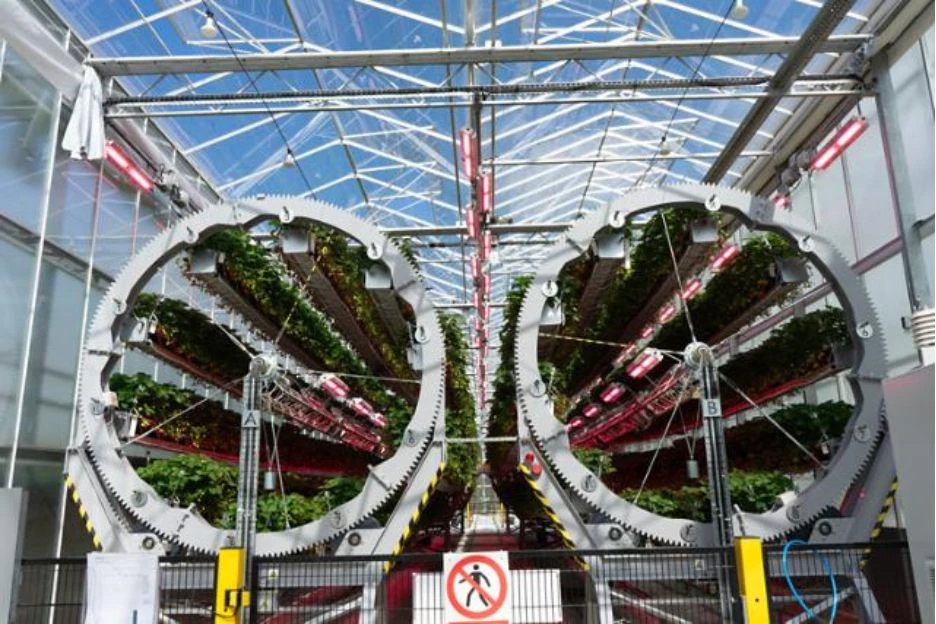
Agricultural innovation is frequently illustrated through autonomous farms, artificial intelligence, robotics, sophisticated sensors and highly controlled production systems.
Those solutions may have enormous value, but Mukhtar warned against treating the most advanced available technology as synonymous with agricultural innovation.
“We need to democratize the innovation, not just essentially the technologies.”
For much of the global agricultural sector, the most transformative intervention may not be a fully automated farm.
It could be better mechanisation. A more accessible irrigation system. Improved agronomy. Digital advisory services. Affordable sensing equipment. Better access to financing.
Gordon-Smith described this principle during the discussion as choosing the “right tech”: considering low-, mid- and high-tech solutions according to the conditions in which they will actually be deployed.
Mukhtar believes the biggest gap may lie precisely in that middle ground.
“Let us focus on that middle part, which is often ignored.”
Bridging institutions, public-sector support, private-sector delivery, financing and targeted subsidies could therefore become as important as the technology itself in determining whether innovation meaningfully improves food security.
Building resilience before building sophistication
The discussion's shift to Yemen provided an even sharper illustration of why context matters.
In a severely disrupted agricultural system, introducing sophisticated technology cannot be the first step.
Livestock systems need to function. Feed must be available. Rural livelihoods must be restored. Farmers need the capacity to work. Supply chains and agricultural structures need to be rebuilt.
Only then can conversations about more advanced improvements in production and productivity begin.
Mukhtar described the challenge as rebuilding an “almost broken agri-food system”, highlighting the importance of recovery before optimisation.
The contrast between technologically advanced Gulf agriculture and agricultural recovery in Yemen reinforces one of the webinar's most important themes: there is no universal technological solution to food security.
Solutions have to fit the system.
Designing agriculture for a +2°C world
The need for that systems thinking will become even more urgent as the climate changes.
Mukhtar previewed his Growtech discussion around farming in a +2°C world, exploring how agriculture must evolve as temperatures rise and water stress intensifies.
Higher temperatures, increasing water scarcity and more erratic weather patterns could force agricultural systems across the region to reconsider what they grow, where they grow it, how resources are allocated and which technologies receive investment.
For Mukhtar, however, the disruption also creates an opportunity to deliberately redesign the system rather than simply respond to events as they unfold.
His closing question captured that challenge:
“Why don't we design this reset rather than being a victim of the reset?”
That reset will require more than policymakers. It will involve private companies, farmers, technology providers, investors, researchers, academia and institutions working together to create practical interventions capable of operating under increasingly difficult conditions.
And perhaps most importantly, it will require moving beyond simple measures of success.
More production is not automatically greater resilience. More technology is not automatically greater productivity. And greater self-sufficiency is not automatically greater food security.
The challenge for the Middle East is to determine the right combination of each.
Watch the full conversation
The webinar only begins to unpack the questions surrounding water, technology accessibility, climate adaptation, agricultural policy and the future of food security across the Middle East.
Watch the full Growtech Middle East webinar to hear the complete conversation between Henry Gordon-Smith and Ahmad Mukhtar and explore their perspectives on how the region can build a more resilient agri-food system.
Ahmad Mukhtar
Subregional Coordinator for GCC States and Yemen
FAO Representative to the United Arab Emirates