Moving From Basic Agricultural Digitization Toward AI-Enabled Agriculture
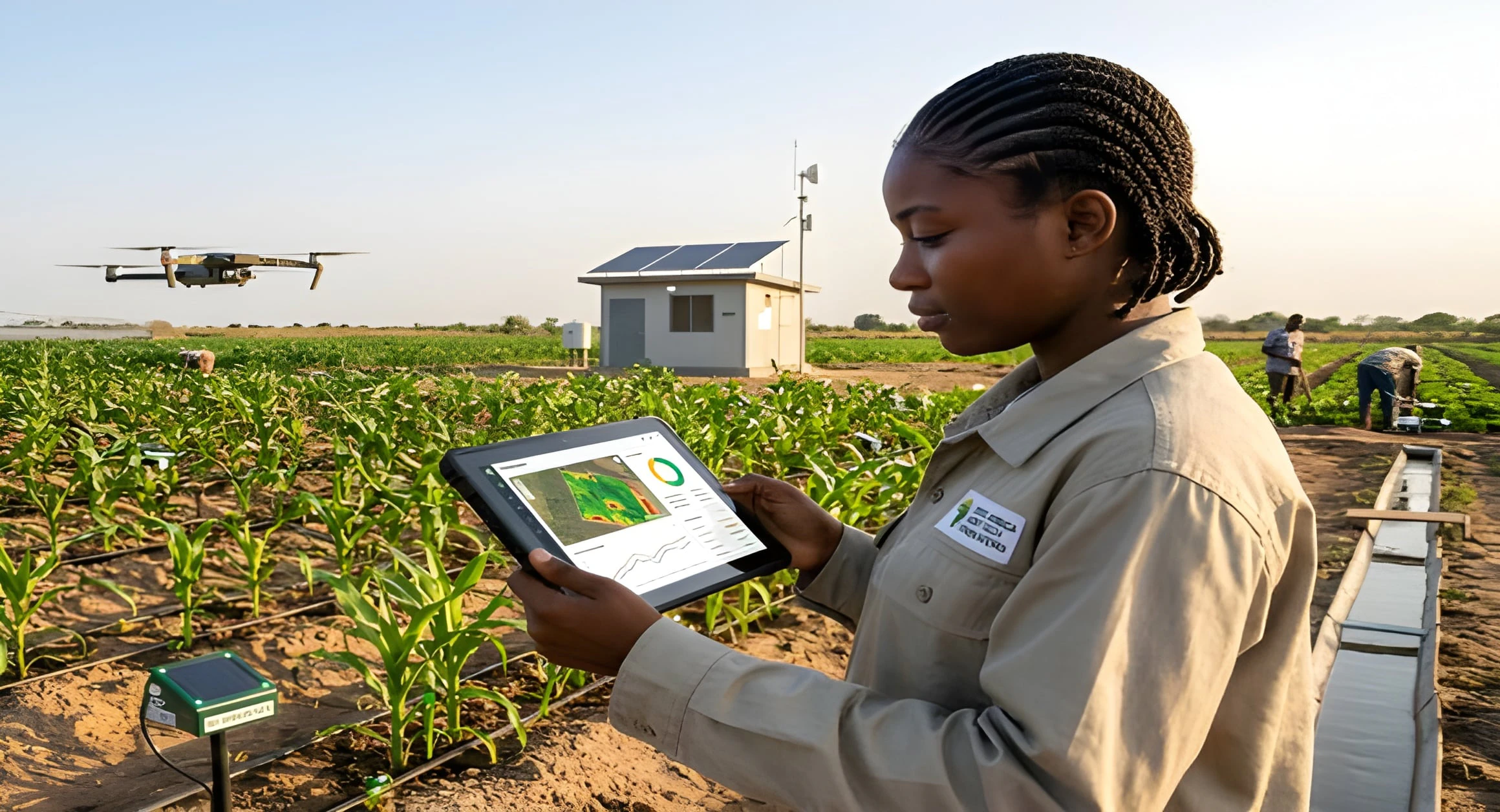
AI and digital agricultural technologies are growing rapidly in West Africa, but adoption remains uneven and is still largely at the pilot and early-scaling stage. Governments, agribusinesses, development organizations and technology start-ups are increasingly using mobile platforms, satellite imagery, drones, IoT sensors, digital marketplaces, AI advisory tools and data analytics to improve farm productivity and resilience.
There are already examples of meaningful digital adoption across the region. In Côte d’Ivoire, the World Bank-supported e-Agriculture Project benefited more than 400,000 people working in agricultural value chains, while the Benin Digital Rural Transformation Project enrolled more than 103,000 people onto digital platforms designed to improve access to information, farm machinery and decision-making tools. [1]
Nigeria is also progressing its digital agriculture agenda. The Federal Government and the Food and Agriculture Organization of the United Nations are working towards a National Integrated Digital Agriculture Platform (NIDAP) intended to connect farmers, farms, inputs, climate information, finance, commodities, research, processors, transporters, retailers and other participants across the agricultural value chain. [2]
Key Challenges
1. Poor Rural Connectivity
Limited internet and mobile broadband coverage restrict farmers' access to AI and digital services, particularly in remote farming communities.
2. Limited Electricity Access
Unreliable electricity makes it difficult to operate smartphones, sensors, irrigation systems and other digital equipment consistently.
3. High Technology Costs
Drones, sensors, smart irrigation equipment, farm-management platforms and data services can be unaffordable for smallholder farmers.
4. Limited Digital Literacy
Many farmers require training before they can confidently use digital platforms and interpret technology-generated recommendations.
5. Lack of Local Agricultural Data
AI models often lack sufficient data on West African soils, crops, weather patterns, pests, farming practices and local languages, reducing the accuracy of recommendations.
6. Fragmented Smallholder Farming
Small and scattered farms make data collection, precision farming and commercial deployment more difficult.
7. Weak Data Systems and Governance
Agricultural data remain fragmented across governments, companies, researchers and farmers, while questions around ownership, privacy and sharing remain unresolved.
8. Limited Technical Skills
There is a shortage of specialists capable of developing, maintaining and adapting advanced agricultural technologies locally.
9. Gender and Inclusion Gaps
Women, poorer farmers and communities with limited access to smartphones or finance can be excluded from technology-driven agricultural services.
10. Difficulty Scaling Successful Pilots
Many promising AgTech projects work at demonstration scale but struggle to become commercially sustainable and reach millions of farmers.
The Emerging Opportunities in West Africa

For West African countries such as Nigeria, Ghana and Côte d’Ivoire, the strongest opportunity is to move beyond simply digitizing agriculture and use AI and precision technologies to give smallholders practical, field-level decisions that improve yields, reduce input waste and strengthen climate resilience. The biggest opportunity is to make precision agriculture affordable, mobile, local-language and farmer-friendly, turning AI from a high-tech concept into a practical daily decision-support tool for millions of smallholders.
- AI-powered precision farming: AI can combine satellite imagery, GPS, weather data, soil information and farm records to provide recommendations tailored to individual fields which can help identify crop stress and nutrient deficiencies early, recommend appropriate fertilizer rates and application timing, detect pest and disease risks, identify areas requiring irrigation, monitor crop growth remotely, reduce unnecessary use of fertilizer, water and pesticides. This creates an opportunity for low-cost "precision farming as a service", where smallholders access sophisticated technology through a mobile phone rather than purchasing expensive equipment themselves.
- Mobile AI agricultural advisers: A major opportunity is to deliver agricultural advice through WhatsApp, SMS, voice/IVR and mobile applications rather than requiring farmers to use sophisticated software. Farmers could receive guidance covering when to plant, what seed to use, when to fertilise and irrigate, pest alerts, harvesting and market timing.Côte d’Ivoire demonstrates the potential of digital advisory at scale. Under its e-Agriculture Project, an agricultural observatory delivered advisory and agro-meteorological information through SMS, mobile applications, web services and a telephone call centre. Over the duration of the project, more than 11 million agricultural advisory messages were sent, with 44% reaching women. [1]
Nigeria is also developing this model through its Digital Precision Agricultural Extension (DPAE) platform. The service provides localised agricultural guidance to smallholder farmers through automated voice calls in Hausa, tailored to the farmer’s location, crop and stage of the season. During its initial rollout, the platform reached approximately 20,000 farmers across eight northern states, with plans for further expansion. [3]
In June 2026, Nigeria’s Federal Ministry of Agriculture and Food Security, the World Bank-funded ACReSAL project and partners also began transitioning the platform towards long-term government operation, with the broader ambition of expanding digital advisory services to significantly more farmers. [4]
- Digital farm-management software: Simple farm-management platforms can help smallholders move from informal record keeping towards data-driven farm management. A farmer could record:
Farm size → crop → seed → planting date → fertiliser → labour → expenses → weather → yield → sales → profit
The accumulated data can then support production planning, cost control, yield forecasting, farm profitability analysis, credit assessment, crop insurance and input purchasing.
This is particularly valuable because the same platform can gradually become a farmer's digital farm record and financial profile.The emerging model is:
Farm data → AI analysis → personalised advice → farmer action → farm records → improved yield and profitability.
Moving From Digital Access to Practical Impact
West Africa’s agricultural transformation will not be defined simply by how many digital tools become available. The bigger test will be whether those tools can become affordable, accessible and useful enough to solve real problems for farmers.
The region already has evidence that digital marketplaces, advisory platforms and mobile services can reach large numbers of agricultural users. The next step is to build on that foundation with locally relevant AI, stronger agricultural data systems and scalable delivery models that translate technology into better farm-level decisions.
Ultimately, the opportunity is not simply to digitise agriculture, but to create an ecosystem where data, AI and practical farmer knowledge work together to improve productivity, profitability and resilience.
[1] World Bank: From Fields to Markets: The Role of Digital Platforms in West Africa’s Agricultural Success (2025). Covers the Côte d’Ivoire e-Agriculture Project, Benin Digital Rural Transformation Project, Agristore and the 11 million advisory messages.
[2] Food and Agriculture Organization of the United Nations: FG, FAO Champion Digital Transformation to Revolutionize Nigeria’s Agricultural Sector (2025). Covers the development of Nigeria’s National Integrated Digital Agriculture Platform.
[3] Precision Development: Digital Precision Agricultural Extension (DPAE) Platform Nigeria. Covers the platform’s structure, delivery model and initial reach of approximately 20,000 farmers.
[4] Federal Ministry of Information and National Orientation, Nigeria: FMAFS and ACReSAL Partner with World Bank to Transition Digital Precision Agricultural Extension Platform for Enhanced Climate Resilience (2026). Covers the transition of DPAE towards government operation and its planned expansion.